

The BAIC Xingtan 5X went on sale in China on 12 November 2026 as the first model of Xingtan, a new line under BAIC Off-Road positioned below the premium Tantalum range. It is a 4,865 mm five-seat box SUV available as a battery-electric car with 625 km of CLTC range or as a plug-in hybrid with 310 km electric and 1,350 km combined. For buyers sourcing Chinese new-energy SUVs, the useful fact is the pre-sale result: 30,208 orders in 23 days.
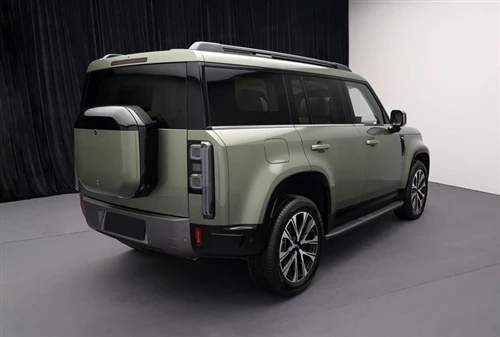
BAIC Xingtan 5X, rear three-quarter
Why this one is worth a look
Three things separate it from the box-shaped SUVs already moving through Chinese ports. First, it is a clean-sheet model rather than a restyle: new brand, new platform, no shared body with anything BAIC sells today. Second, there are two powertrains with genuinely different duty cycles - an 800 V electric car that charges 30–80 per cent in 14.5 minutes, and a hybrid with a 59-litre tank for markets where charging is the constraint. Third, the off-road hardware is real enough to matter without turning the car into a truck: 228 mm of ground clearance, 600 mm of wading depth, 26/28-degree approach and departure angles, and a rear differential lock on the all-wheel-drive hybrids.
Powertrain and running gear
The electric version is rear-drive only: one 227 kW, 334 Nm motor, an 81.9 kWh lithium iron phosphate pack from EVE, 625 km CLTC, 15.1 kWh per 100 km, and a 96-litre front boot. Kerb weight is 2,135 kg. The hybrid pairs a 1,498 mL turbo four (105 kW, 235 Nm, 92-octane) with a single-speed dedicated hybrid transmission. Front-wheel drive adds a 200 kW motor for 272 PS; all-wheel drive adds a second motor for 400 kW / 654 Nm, or 544 PS. Both hybrids use a 50.4 kWh Sunwoda pack and a 59-litre tank, returning 310 km or 285 km of CLTC electric range, 1,350 or 1,250 km combined, and 6.19 or 6.69 L/100 km in charge-sustaining WLTC running. Only the all-wheel-drive cars are rated to tow 1,600 kg.
The cabin is the sales argument
Two 15.6-inch 2.5K displays share a single panel, with a passenger-side screen on the higher trims, plus an 8.8-inch instrument display and a cabin layout BAIC describes as 268-degree wraparound. Equipment that tends to matter in export markets is present: an 8.2-litre double-door compressor fridge running from minus 6 to 50 degrees Celsius, 6 kW vehicle-to-load output, an opening panoramic roof, IP68 electricals rated for 1.5 m of water for two hours, and 2,231 litres of load space with the rear seats folded. The front seats drop flat to make a 1.75 m bed. Audio is eight speakers as standard, with a 23-speaker system as an option.
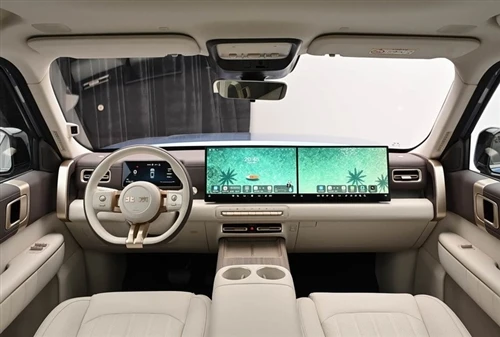
Cabin with the dual 15.6-inch screens
Two electronics tiers to specify carefully
Four of the seven trims carry Huawei ADS 5 Pro, with one solid-state lidar mounted inside the cabin behind the windscreen, eleven cameras, 27 sensors and city plus highway assistance. The other three run a Snapdragon 8155 with 4G and five cameras, with no lidar and no branded assistance system. The visible hardware is almost identical, so trim selection has to be driven by the specification sheet rather than the showroom car. Cabin software is BEIJING OS with a Yuanjing AI layer built on the Doubao model.
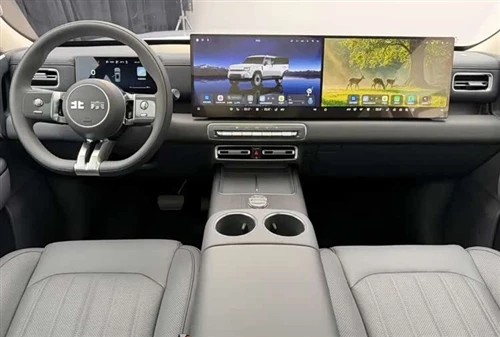
Front-row screen layout and centre console
Specifications
| Specification | EV 625 Standard | EV 625 Huawei ADAS | PHEV 310 2WD | PHEV 285 4WD | PHEV 285 4WD Huawei ADAS |
|---|---|---|---|---|---|
| Body type | 5-door, 5-seat SUV | 5-door, 5-seat SUV | 5-door, 5-seat SUV | 5-door, 5-seat SUV | 5-door, 5-seat SUV |
| L × W × H (mm) | 4865×2000×1910 | 4865×2000×1910 | 4865×2000×1910 | 4865×2000×1910 | 4865×2000×1910 |
| Wheelbase (mm) | 2875 | 2875 | 2875 | 2875 | 2875 |
| Kerb weight (kg) | 2135 | 2135 | 2160 | 2310 | 2310 |
| Gross vehicle weight (kg) | 2625 | 2625 | 2650 | 2790 | 2790 |
| Approach / departure / breakover | 26° / 28° / 23° | 26° / 28° / 23° | 26° / 28° / 23° | 26° / 28° / 23° | 26° / 28° / 23° |
| Ground clearance / wading (mm) | 228 / 600 | 228 / 600 | 228 / 600 | 228 / 600 | 228 / 600 |
| Powertrain | BEV | BEV | PHEV | PHEV | PHEV |
| Engine | - | - | A156T2H 1.5T L4, 1498 mL, 105 kW / 235 N·m | A156T2H 1.5T L4, 1498 mL, 105 kW / 235 N·m | A156T2H 1.5T L4, 1498 mL, 105 kW / 235 N·m |
| Front motor | - | - | 200 kW / 320 N·m | 200 kW / 320 N·m | 200 kW / 320 N·m |
| Rear motor | 227 kW / 334 N·m | 227 kW / 334 N·m | - | 200 kW / 327 N·m | 200 kW / 327 N·m |
| System output | 227 kW / 309 Ps | 227 kW / 309 Ps | 272 Ps | 544 Ps | 544 Ps |
| Battery | 81.9 kWh LFP (EVE cells) | 81.9 kWh LFP (EVE cells) | 50.4 kWh (Sunwoda) | 50.4 kWh (Sunwoda) | 50.4 kWh (Sunwoda) |
| CLTC electric range | 625 km | 625 km | 310 km | 285 km | 285 km |
| WLTC electric range | - | - | 232 km | 210 km | 210 km |
| CLTC combined range | - | - | 1,350 km | 1,250 km | 1,250 km |
| WLTC fuel use, charge-sustaining | - | - | 6.19 L/100 km | 6.69 L/100 km | 6.69 L/100 km |
| Fuel tank | - | - | 59 L | 59 L | 59 L |
| 30–80% fast charge | 14.5 min (800 V) | 14.5 min (800 V) | - | - | - |
| Drivetrain | RWD | RWD | FWD | AWD | AWD |
| Transmission | Single-speed | Single-speed | 1-speed DHT | 1-speed DHT | 1-speed DHT |
| Top speed (km/h) | 200 | 200 | 200 | 200 | 200 |
| 0–100 km/h (s) | - | - | - | - | - |
| Suspension | MacPherson front / multi-link rear, unibody | MacPherson front / multi-link rear, unibody | MacPherson front / multi-link rear, unibody | MacPherson front / multi-link rear, unibody | MacPherson front / multi-link rear, unibody |
| Tyres | 255/55 R20 (opt. 255/50 R21, 255/60 R19) | 255/55 R20 (opt. 255/50 R21, 255/60 R19) | 255/55 R20 (opt. 255/50 R21, 255/60 R19) | 255/55 R20 (opt. 255/50 R21, 255/60 R19) | 255/55 R20 (opt. 255/50 R21, 255/60 R19) |
| Cabin chip / network | Snapdragon 8155 / 4G | Snapdragon 8295P / 5G | Snapdragon 8155 / 4G | Snapdragon 8155 / 4G | Snapdragon 8295P / 5G |
| Screens | Dual 15.6-inch 2.5K + 8.8-inch cluster | Dual 15.6-inch 2.5K + 8.8-inch cluster | Dual 15.6-inch 2.5K + 8.8-inch cluster | Dual 15.6-inch 2.5K + 8.8-inch cluster | Dual 15.6-inch 2.5K + 8.8-inch cluster |
| Driver assistance | - | Huawei ADS 5 Pro (city + highway) | - | - | Huawei ADS 5 Pro (city + highway) |
| LiDAR / cameras / sensors | - / 5 / - | 1 in-cabin solid-state / 11 / 27 | - / 5 / - | - / 5 / - | 1 in-cabin solid-state / 11 / 27 |
| Rear axle diff lock | - | - | - | Standard | Standard |
| Boot volume, seats folded (L) | 2231 | 2231 | 2231 | 2231 | 2231 |
| Vehicle warranty | 5 years / 150,000 km, battery lifetime for first owner | 5 years / 150,000 km, battery lifetime for first owner | 5 years / 150,000 km, battery lifetime for first owner | 5 years / 150,000 km, battery lifetime for first owner | 5 years / 150,000 km, battery lifetime for first owner |
| FOB price (USD) | 20,900 * | ||||
Figures as published on Autohome (spec 78798) for the 2026 model year, five of the seven trims shown. A dash means the manufacturer has not published a value. * FOB is an estimate derived from the entry-trim guide price under our standard formula; it is not a quotation and moves with configuration and volume.
FAQ
Short answer: a new five-seat Chinese SUV from BAIC's new Xingtan brand, offered as a 625 km rear-drive electric car or a 310/285 km plug-in hybrid, with 2,231 litres of load space, a 1,600 kg towing rating on all-wheel-drive hybrids and Huawei city assistance on four of seven trims. Chinese deliveries began on 12 November 2026.
- Is the Xingtan 5X available for export now?
Domestic sales started on 12 November 2026. Export volume depends on allocation and homologation in the destination market. Send us the destination port and required configuration for current lead times. - What is the FOB price?
Indicative FOB is USD 20,900, calculated from the entry-trim guide price under our standard formula. It is an estimate rather than a quoted price and changes with configuration, volume and destination. - Which trims tow 1,600 kg?
Only the two all-wheel-drive hybrids, which also carry the rear differential lock. Front-drive and electric versions are not rated to tow. - Left-hand drive only?
All announced specifications are left-hand drive. No right-hand-drive programme has been confirmed. - Five or six seats?
Five. There is no third row, which is why the second row and the boot are usable rather than nominal.