


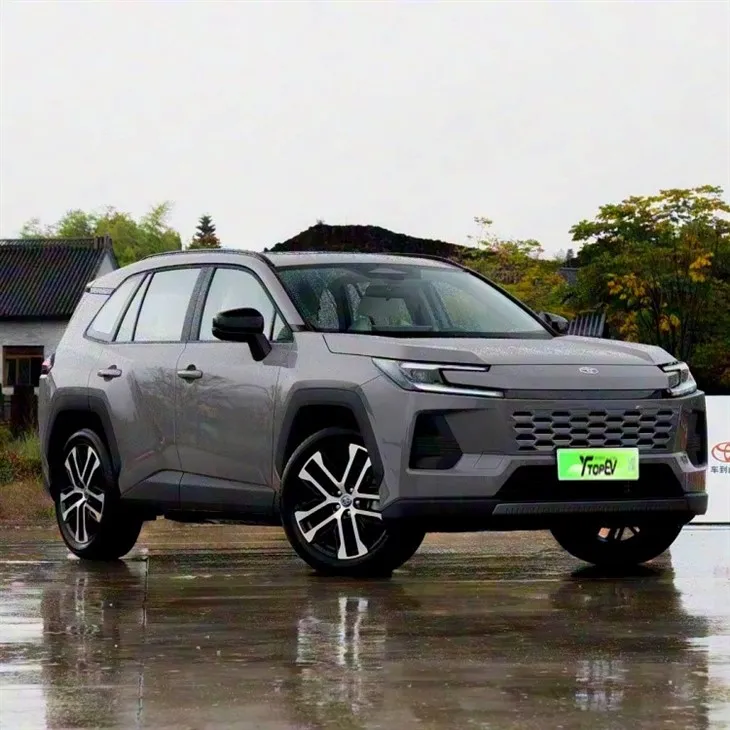
In the compact SUV market, the 2026 Toyota Wildlander has undergone a complete overhaul, continuing Toyota's legacy of reliability while making breakthroughs in core dimensions. Regarding the popular comparison between Wildlander and RAV4, it provides a solid answer through real product strength, making it the top choice for family users.
Exterior Design: Bold Aesthetics, Balancing Practicality and Personality


The 2026 Toyota Wildlander features a "Sharp Power Aesthetics" design, completely breaking away from the dull appearance of typical family SUVs. The nearly vertical front end, paired with the borderless honeycomb grille, creates a "Hammerhead Shark" style front face that makes a strong visual impact. It is more sporty than the design of the 2024 Honda CRV E:HEV 2.0L 2WD Compact.


The C-shaped LED headlamp group and the "piano key" vertical LED tail lights complement each other, creating a flowing lighting effect that maximizes nighttime recognition, surpassing the Nissan X-Trail E-POWER in terms of lighting design. The side profile features flared wheel arches paired with a Y-shaped waistline, outlining full muscular lines. The 20-inch cut wheels are standard across the range, exuding a presence far greater than the 17-inch wheels on the Toyota RAV4 2026 entry-level version.


With dimensions of 4600mm×1855mm×1680mm and a 2690mm wheelbase, the Wildlander offers both city maneuverability and spacious passenger space. The newly added Cyber Gray/Black two-tone option combines practicality with individuality, better aligning with global family aesthetics compared to the flamboyant design of the Geely Xingyue L 2.0TD. Many users wonder, Is the Wildlander bigger than a RAV4? The answer is clear: its wheelbase is 10mm longer than the Toyota RAV4 2026, providing superior actual space.
Intelligent Cabin: Smooth Experience, Leading-Edge Features
The cabin of the Toyota Wildlander upgrades directly address user pain points. The 15.6-inch ultra-narrow bezel floating central screen is standard across the range. Equipped with the Qualcomm Snapdragon 8155P chip, interface switching and zooming navigation are seamless, solving the common issue of lag in the Toyota RAV4 2026 infotainment system. It is also more practical than the smaller 12.3-inch screen in the Nissan X-Trail E-POWER.


Deeply integrated into the HarmonyOS cabin ecosystem, the system supports four-zone voice interaction. The front and rear passengers can precisely control the vehicle's functions with over 98% recognition, and it supports multiple dialects. This feature is better suited for family use compared to the dual-zone voice system of the 2024 Honda CRV E.
A 26.4-inch HUD projection is an upgraded feature, with slanted transparency technology allowing clear visibility even under strong sunlight. Core information is displayed in layers, so users can obtain data without looking down. Compared to the BYD Song Plus EV 2023, which relies on touchscreen operations, this system is safer. The infotainment system fully supports CarPlay, HUAWEI HiCar, and Carlink connectivity, preloaded with 26 top apps, and offers four OTA updates per year, ensuring the vehicle remains "newer the more you use it."
Power System: Hybrid Benchmark, Excellent Fuel Efficiency and Range
The Toyota Wildlander is equipped with the fifth-generation intelligent hybrid system, making it a leader in its class. The 2.0L HEV version has a combined fuel consumption as low as 4.59L/100km, and with a full tank of gas, it can travel up to 1500km, with the all-wheel-drive version reaching 1300km, completely eliminating range anxiety. In comparison, the Nissan X-Trail E-POWER has a combined fuel consumption of 6.36L/100km, showing a clear difference.


The 2.5L HEV all-wheel-drive version has a combined power of 163kW (222Ps), improving power by 7% while reducing fuel consumption by 6%. It starts smoothly like an electric car and has sufficient power reserve for acceleration at high speeds. While the 2024 Honda CRV E is said to have low fuel consumption, it relies on charging to maintain it, whereas the Toyota Wildlander delivers stable low fuel consumption without the need for charging, making it more practical.


The fuel version comes with a 2.0L naturally aspirated engine, with a combined fuel consumption of 6.39-6.85L/100km, which is more economical than the Geely Xingyue L 2.0TD's 7.79L/100km, offering substantial savings in long-term use. The all-wheel-drive versions are varied, with the E-Four electronic four-wheel-drive system achieving a 20:80 torque distribution, offering better traction on slippery roads compared to the two-wheel-drive layout of the 2024 Honda CRV E:HEV 2.0L 2WD.
Safety Protection: Full Domain Protection, Combining Soft and Hard Strength
The Toyota Wildlander comes standard with the TSS 4.0 Intelligent Safety System, equipped with 24 sensors, including an 8.3-million-pixel forward camera that detects up to 280 meters, accurately identifying various road conditions and covering over 200 functional scenarios. This configuration far surpasses the TSS 3.0 system in the Toyota RAV4 2026, which only has 16 sensors.
In highway scenarios, the full-speed adaptive cruise control and lane centering assist can achieve "quasi-L3 level" driving assistance, with smooth acceleration and deceleration and natural lane centering. In urban commutes, the system can predict neighboring cars cutting in 1.2 seconds ahead and smoothly decelerate to avoid sudden jolts, making it safer than the Honda SENSING system in the 2024 Honda CRV E:HEV 2.0L 2WD Compact Hybrid SUV.


The passive safety features are fully equipped: BFI integrated body with more than 70% high-strength steel, front anti-collision beams made from 1700MPa high-strength material, enhancing body rigidity by 9.7%; all models come standard with six airbags, outperforming the Nissan X-Trail E-POWER Hybrid SUV, which has only four airbags in the lower trims.
Space Utilization: Efficient Use, Meeting Family Needs
The Toyota Wildlander excels in "space utilization," with a 2690mm wheelbase and a "short front and rear overhang" design, providing over two fist lengths of legroom in the rear and three fingers of headroom, ensuring no discomfort even with full occupancy. The near-flat rear floor allows the middle passenger to sit without bending their legs, a major advantage over the Toyota RAV4 2026, which has a pronounced rear hump. It is also more practical than the overly long body of the Geely Xingyue L 2.0TD Compact SUV, which makes parking inconvenient.


In regular configuration, the trunk has a volume of 580L, and with the rear seats folded in a 4:6 ratio, it expands to 1600L, easily accommodating camping gear, strollers, or large furniture. There are over 20 storage compartments throughout the vehicle, including a large-capacity compartment under the central console with 50W wireless fast charging, and the door panel storage slots can hold large bottles of water. These practical details surpass the Nissan X-Trail E-POWER Hybrid SUV.


The central armrest box can be opened from both sides and flipped into a non-slip storage platform. The dual-zone air conditioning system, paired with an onboard purification system and ion generator, ensures the new car has almost no odor. This perfectly addresses the question, Is the Wildlander a good family car? – from space utilization to comfort features, it precisely meets the core needs of family travel.
Cost Performance: More Features at a Competitive Price
The 2026 Toyota Wildlander has a more competitive starting price, about $3000 lower than the 2024 Honda CRV E:HEV 2.0L 2WD Compact Hybrid SUV and $2500 lower than the Toyota RAV4 2026 hybrid version. Its standard features, such as the 15.6-inch screen, TSS 4.0 system, and six airbags, are typically only available on mid-to-high trims of competitors, making the Wildlander a clear winner in terms of value.
The entire vehicle comes with a three-year or 100,000-kilometer warranty, and the hybrid version's battery pack comes with a lifetime warranty for the first owner, completely addressing concerns about hybrid systems. Compared to the potential risks of battery degradation in the BYD Song Plus EV 2023, this warranty policy demonstrates great sincerity. The new domain control architecture supports full-domain OTA upgrades, allowing remote optimization of engine PCU firmware and transmission shift logic, ensuring the vehicle continues to evolve throughout its lifecycle. This is an advantage that traditional models like the Nissan X-Trail E-POWER Hybrid SUV cannot match.
As the answer to What is Toyota's best-selling SUV?, the Toyota Wildlander has achieved a cumulative global sales figure of over 15 million units, with its reliable quality and balanced performance earning recognition from global users. Facing the dilemma of Which is better, RAV4 or Highlander?, it provides the optimal solution: more features and space than the Toyota RAV4 2026, and more affordable and fuel-efficient than the Toyota Highlander, making it the "golden choice" for most families.
The 2026 Toyota Wildlander stands out in the family SUV market with its comprehensive advantages in design, configuration, fuel efficiency, safety, space, and cost-performance. It not only meets the surface-level needs of users but also addresses deep concerns with its high-standard quality and long warranty. If you're looking for a "can't go wrong" family SUV, the Toyota Wildlander is well worth exploring. Feel free to contact us anytime to start your high-quality travel journey!
Toyota Wildlander 2026 Parameters
| Parameters | 2.0L AIR | 2.0L PRO | 2.0L PRO+ | 2.0L AWD PRO+ |
| EXW | $24,923 | $26,593 | $27,985 | $29,377 |
| Manufacturers | GAC Toyota | GAC Toyota | GAC Toyota | GAC Toyota |
| level | compact SUV | compact SUV | compact SUV | compact SUV |
| Energy type | gasoline | gasoline | gasoline | gasoline |
| Launch date | Nov-25 | Nov-25 | Nov-25 | Nov-25 |
| Body type | 5-door 5-seater SUV | 5-door 5-seater SUV | 5-door 5-seater SUV | 5-door 5-seater SUV |
| Length × Width × Height (mm) | 4600×1855×1680 | 4600×1855×1680 | 4600×1855×1680 | 4600×1855×1680 |
| Wheelbase (mm) | 2690 | 2690 | 2690 | 2690 |
| Maximum speed (km/h) | 180 | 180 | 180 | 180 |
| WLTC combined fuel consumption (L/100km) | 6.29 | 6.29 | 6.49 | 6.89 |
| Maximum load capacity (kg) | 2115 | 2115 | 2115 | 2150 |
| Engine Model | M20C | M20C | M20C | M20C |
| Displacement (L) | 2 | 2 | 2 | 2 |
| Intake form | Natural inhalation | Natural inhalation | Natural inhalation | Natural inhalation |
| layout | Horizontal | Horizontal | Horizontal | Horizontal |
| Maximum horsepower (Ps) | 171 | 171 | 171 | 171 |
| Maximum power (kW/rpm) | 126/6600 | 126/6600 | 126/6600 | 126/6600 |
| Maximum torque (N·m/rpm) | 206/4600-5000 | 206/4600-5000 | 206/4600-5000 | 206/4600-5000 |
| gearbox | Continuously variable transmission | Continuously variable transmission | Continuously variable transmission | Continuously variable transmission |
| driving method | Front-engine, front-wheel drive | Front-engine, front-wheel drive | Front-engine, front-wheel drive | Front-engine, four-wheel drive |
| Four-wheel drive | - | - | - | Part-time four-wheel drive |
| Central differential structure | - | - | - | Multi-plate clutch |
| Front suspension type | MacPherson independent suspension | MacPherson independent suspension | MacPherson independent suspension | MacPherson independent suspension |
| Rear suspension type | E-type multi-link independent suspension | E-type multi-link independent suspension | E-type multi-link independent suspension | E-type multi-link independent suspension |
| Steering power type | Electric Assist | Electric Assist | Electric Assist | Electric Assist |
| Vehicle body structure | Load-bearing | Load-bearing | Load-bearing | Load-bearing |
| Front brake type | Ventilation disc | Ventilation disc | Ventilation disc | Ventilation disc |
| Rear brake type | disc | disc | disc | disc |
| Parking brake type | Electronic parking brake | Electronic parking brake | Electronic parking brake | Electronic parking brake |
| Tire specifications | 235/60 R18 | 235/60 R18 | 235/50 R20 | 235/50 R20 |
| Spare tire specifications | Non-full size | Non-full size | Non-full size | Non-full size |
FAQ
Q1: What is the core difference between Wildlander and RAV4?
A1: The 2026 Toyota Wildlander has a 10mm longer wheelbase than the Toyota RAV4 2026. It comes standard with a 15.6-inch screen and Snapdragon 8155P chip, the TSS 4.0 safety system is more comprehensive, and the hybrid version has 5% lower fuel consumption. With higher features and a more affordable price, the Wildlander is the superior choice in terms of overall strength.
Q2: Is the Wildlander bigger than a RAV4?
A2: Yes. The Toyota Wildlander has a body width of 1855mm and a wheelbase of 2690mm, both of which are superior to the Toyota RAV4 2026. The rear seat offers more space both horizontally and for legroom, and the trunk has 50L more capacity.
Q3: Is the Wildlander a good family car?
A3: Absolutely, it's a top choice in its class. It features a nearly flat rear floor, over 20 storage compartments, a full-domain safety system, and a low fuel consumption hybrid version that lowers family car usage costs. It is far more practical than competitors like the Nissan X-Trail E-POWER Hybrid SUV.
Q4: Which Toyota SUV is considered luxury?
A4: The Wildlander Luxury Plus is regarded as the "affordable luxury" benchmark. It is equipped with features such as leather seats, ventilated and heated front seats, and an intelligent screen, with an interior that features 80% soft-touch materials, offering a feel comparable to entry-level luxury brands.
Q5: Is the Outlander bigger than a RAV4?
A5: The Nissan X-Trail E-POWER Hybrid SUV (overseas version of Outlander) has slightly larger dimensions than the Toyota RAV4 2026 on paper. However, the actual passenger space is similar to the Toyota Wildlander, while the Wildlander excels in terms of fuel economy, features, and safety.
Hot Tags: toyota wildlander 2026 2.0l, China toyota wildlander 2026 2.0l suppliers